
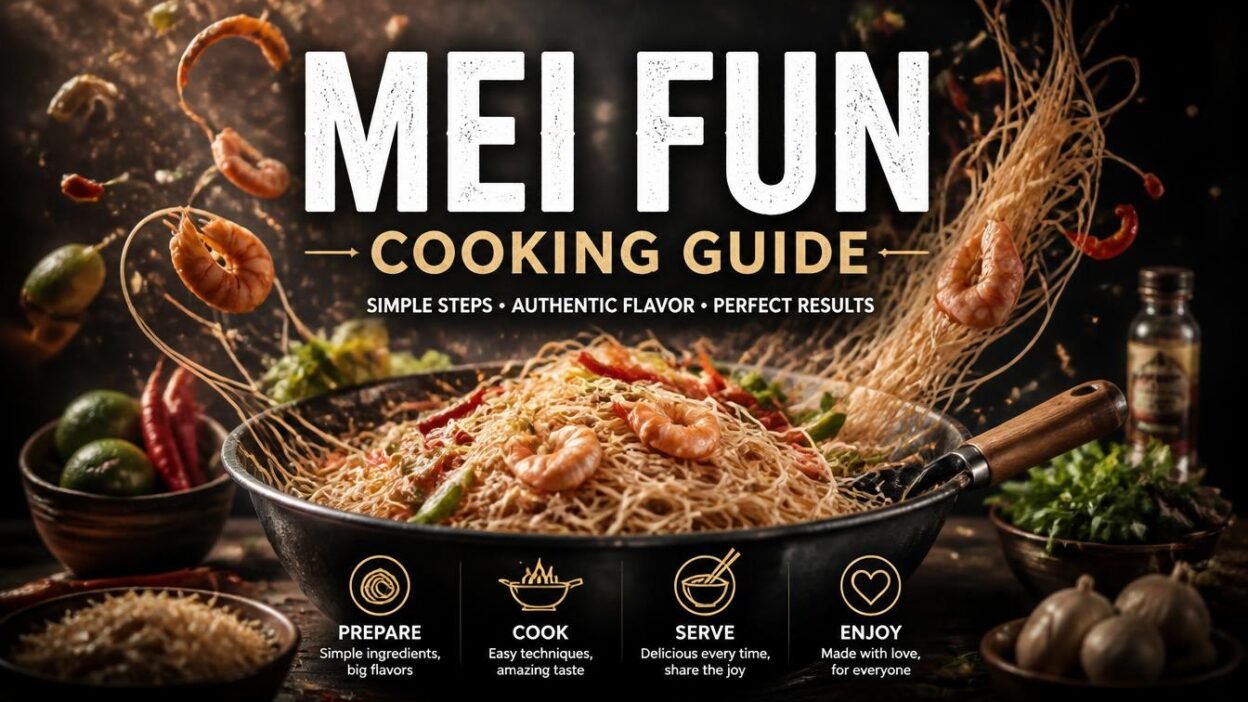
Mei fun has a way of surprising people. You order it expecting a simple noodle dish, and what arrives is a tangle of delicate rice threads, faintly smoky from the wok, studded with vegetables and protein, and light enough that you don’t feel weighed down afterward. Yet for all its simplicity on the plate, mei fun raises plenty of questions once you try to cook it at home. Which noodles do you buy? How do you stop them from turning into a sticky mass? And why does every package seem to use a different name? This guide picks up where the basics leave off, focusing on the practical details that make the difference between a decent stir-fry and one that rivals your favorite restaurant.
What Is Mei Fun, Really, in the Chinese Kitchen?
The term what is mei fun refers to more than just a noodle. In Cantonese, “fun” is a broad category that covers rice noodles of virtually any shape—fresh sheets, wide ribbons, and thin strands alike . “Mei fun” narrows that down to the slender, dried vermicelli-style noodle made from ground rice and water. But here is where it gets interesting: in a traditional Cantonese home, mei fun is less a recipe than a method. It is the thing you reach for when the refrigerator offers odds and ends and dinner needs to happen quickly . That practical, improvisational spirit is what makes the noodle so enduring.
The dried bundles are semi-translucent before cooking, with a faint plastic-like sheen. Once rehydrated, they turn bright white and pliable, with a tendency to clump if you walk away for too long . Understanding that texture is the first step toward cooking them well.
Chow Mei Fun and the Art of the Wok
When you ask what is chow mei fun, you are really asking about technique. “Chow” means stir-fried, and the dish depends on high heat and speed. A proper chow mei fun uses a seasoned carbon steel wok, prepped ingredients within arm’s reach, and a willingness to keep things moving . The goal is wok hei, that faint charred aroma that comes from ingredients hitting a screaming-hot surface.
The protein is usually velveted—tossed with cornstarch and a splash of liquid—so it stays tender under the wok’s aggressive heat . Eggs are scrambled into a thin sheet and broken into pieces. Vegetables like napa cabbage and julienned carrots go in at different stages so nothing turns to mush. And the noodles themselves are added last, tossed gently with tongs rather than stirred violently, so they heat through without breaking . It is a fifteen-minute dance, and it rewards preparation over improvisation.
Singapore Mei Fun: The Curry Connection
The most recognizable variation, Singapore Mei Fun, owes its identity to one ingredient: curry powder. The dish is believed to have originated in Hong Kong during the British colonial period, when curry powder was a common pantry item, and the name was likely borrowed for its exotic association rather than any actual connection to Singapore . Many Singaporeans have never encountered it .
What makes what is singapore mei fun distinctive is the way the curry powder is handled. It is often bloomed in hot oil or whisked into a sauce with oyster sauce and soy sauce before being tossed with the noodles . The result is a golden-yellow tangle with warmth rather than overwhelming heat, punctuated by shrimp, char siu, and thin strips of bell pepper. If you are new to cooking mei fun, this is a forgiving entry point—the curry sauce helps coat the noodles evenly and masks small timing errors.
Is Mei Fun Gluten Free? The Details That Matter
The question is mei fun gluten free has a straightforward answer with a few important exceptions. Traditional mei fun is made from rice and water alone, which makes it naturally gluten-free . However, some manufacturers blend in wheat flour, tapioca, or other starches to adjust texture, so reading the label on the package you are holding is non-negotiable .
The greater risk lies in the sauce. Standard soy sauce contains wheat, and oyster sauce frequently uses wheat flour as a thickener. For a truly gluten-free chow mei fun, you need tamari or a certified gluten-free soy sauce, and you should either find a gluten-free oyster sauce or season with fish sauce and salt instead . When ordering at a restaurant, ask directly; cross-contact in a busy wok kitchen is common.
Vegetable Mei Fun and the Case for Going Meatless
Vegetable mei fun is not a compromise. It is, in many ways, the purest expression of the dish. Because the noodles are neutral, they absorb whatever flavors you build around them. Dried shiitake mushrooms, rehydrated in warm water, bring a deep, meaty umami that holds its own against any protein . Napa cabbage wilts into silky ribbons that cling to the noodles. Bean sprouts add a fresh crunch at the very end, and a drizzle of sesame oil finishes the plate with a toasted note.
The key with a vegetable version is to respect the cooking times of each ingredient. Carrots and cabbage need a head start; bell peppers and scallions go in later; bean sprouts and garlic chives barely need more than a toss . A splash of Shaoxing wine along the way adds complexity without heaviness. Served hot, with a sprinkle of white pepper, it is the kind of weeknight dinner that feels lighter than its takeout counterpart and comes together in less time than delivery would take.
What Is Mei Fun Chinese Food, and Why the Name Confusion?
The phrase what is mei fun chinese food often comes from someone staring at a menu, trying to distinguish it from lo mein or chow fun. The short answer: mei fun is the thin rice noodle; lo mein uses thicker wheat-based noodles; chow fun uses wide, flat rice ribbons . They are entirely different ingredients with different cooking requirements.
The naming confusion does not stop there. Some packages label the same noodle as rice vermicelli, rice sticks, or mai fun—the latter being closer to the Cantonese pronunciation . Glass noodles, meanwhile, look similar in the package but are made from mung bean or sweet potato starch and behave very differently in the wok . If you remember one distinction, make it this: mei fun turns bright white when hydrated, while glass noodles stay translucent.
Practical Notes for the Home Cook
A few small adjustments make home-cooked mei fun noticeably better. Soak the noodles in warm—not boiling—water until they are pliable but still slightly firm in the center; boiling water starts cooking the starches too early and leads to mush . Drain them thoroughly and toss with a few drops of oil if they will sit before hitting the wok. Cook the protein and vegetables in batches so the pan stays hot, and add the noodles only at the end. A well-seasoned wok or a heavy skillet works; what matters is that it is properly preheated before anything goes in .
Mei fun rewards attention to texture more than complexity of flavor. Once you understand how the noodle behaves—how it hydrates, how it clumps, how it responds to heat—the rest is a matter of what you have on hand. That is, in the end, exactly how it has been cooked in Cantonese kitchens for generations.

I’m Thomas Parker, an author and writer passionate about sharing ideas, stories, and perspectives that connect with readers. Through my writing, I explore topics that interest and inspire me, with a focus on creating content that is informative, engaging, and meaningful.
Writing is more than just putting words on a page for me—it’s a way to communicate ideas, explore new perspectives, and connect with people from different backgrounds. I’m always curious, always learning, and always looking for new stories to tell.
Welcome to my website, and I hope you enjoy reading my work.